When a dbt model or test fails, On-Call opens a case and routes it to the agent role that owns that kind of failure. It investigates in its own copy of your project, a second agent tries to refute the fix, and nothing reaches your repo until a named person signs.
Live
A broken number costs the sprint someone dropped to chase it, and the dashboard your CEO stopped trusting.
Add one line after your dbt command. With Elementary, anomalies, schema changes and source freshness open cases too.
| dbt Core models and tests, on the same machine | Live |
| Elementary anomalies, schema changes, source freshness | Live |
| dbt running elsewhere (dbt Cloud, hosted CI) | Next |
| Alerts from Airflow, Dagster, Monte Carlo, Sifflet, SYNQ · Dataform | Roadmap |
| Warehouse: BigQuery | Live |
| Warehouse: Snowflake | Roadmap |
dbt build on itWe grade the crew on failures we cause on purpose. Each broken case runs several times. Code, not the agent that wrote the fix, decides whether it worked: the broken test turns green, nothing that was green breaks, and no data or test was touched. We’ll publish the numbers when the first baseline is done.
dbt test: unique on stg_orders.order_id fails with 14 duplicates. A case opens; triage sends it to the delivery lead.raw_orders received twice: same order_id, different load time. The source re-sent them after a retry. Hands it to the modeling specialist.order_id in stg_orders. Commits it in its own copy and runs dbt build: green.Agents commit fixes in a working copy with no git remote. You sign on The Morning, the screen where everything waiting for your signature is collected: the case, who owns it, how long it has waited, and Sign, Send back, or Take it yourself.
The signed fix arrives as a pull request on a branch, with the case and the signer in the commit. Your branch protection, required checks and reviewers apply. The merge is yours.
| Sign on The Morning, on the On-Call machine | Live |
| Close the case only after dbt passes on the merged fix | Next |
| Diagnosis, diff and the reviewer’s verdict on The Morning itself | Next |
| Sign from Slack | Next |
| Microsoft Teams | Roadmap |
Agents can get things wrong. So whatever must happen every time is done by code, not left to a model.
Repository writes are done by code, only after a person signs.
Today, every fix needs a signature.
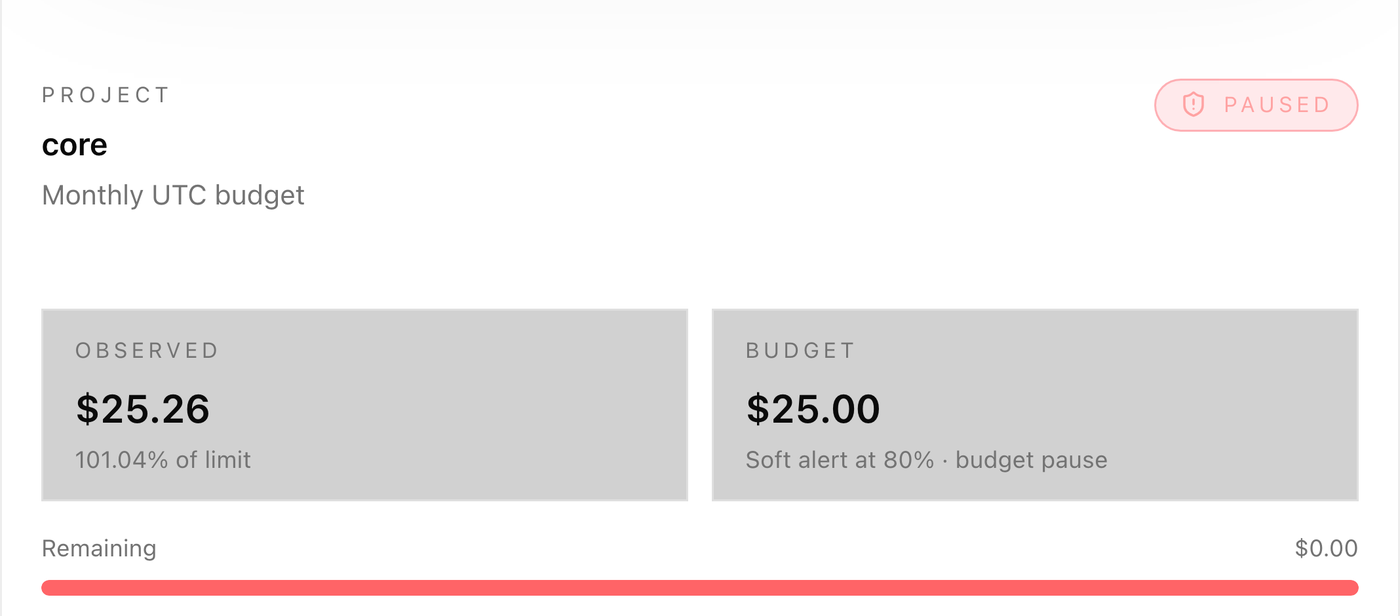
On estimated AI spend, per company and per agent.
After 50 minutes, agents stop and the case waits for a person.
If a failing test passes again before it’s fixed, the agents stop and the case goes to a person, with when it failed, when it passed and how many times. Nothing closes itself. For schema changes and anomalies a pass proves nothing, so the agents keep working.
The dbt group’s owner, or your default signer.
Production changes only through your git and your own deploy, after a named person signs. For your warehouse, the boundary is the key you give the agents (next question).
A warehouse key for the agents. Scope it to a dev dataset and cap its bytes: that scope is the boundary.
Calls to the AI model (with what agents read from your warehouse), warehouse queries, the branch and pull request to your git host, and first-install downloads. Containers aren’t network-isolated.
No observability vendor required. Today the service stops itself after 8 hours.
Next Unattended, continuous service.
Roadmap Alerts from the observability tool you already use, so you can switch without losing your on-call.
Missing one? Tell us.
Tested with dbt Core 1.11 and Elementary 0.23.1. Older versions are next.
Five or more build errors in one run usually share one cause, like the warehouse, a quota or permissions. They make one outage case, for a person.
On your machine, with Docker Compose. You sign from a browser on it.
The signed fix arrives as a pull request on your repo. Your branch protection, required checks and reviewers apply, and the merge is yours. We never ask you to relax them.
No. It takes the first pass. Outages and unit-test failures go to a person.
Pricing isn’t set yet. Tell us about your stack.
On-Call is the first job of Crewdata’s AI data team: the one data engineers like least. The same organization of roles, review and signatures is built to take on more of the job next: quality, governance, catalog and analytics.